Perspective
Supermoons and Micromoons, Explained
A supermoon is a full moon near its closest point to Earth. A micromoon is the opposite. Here's what actually changes, and how rare they really are.
A supermoon looks bigger and brighter than an ordinary full moon. A micromoon looks smaller and dimmer. Neither term describes anything mysterious, just where the moon happens to sit in its orbit at the moment it turns full.
Where the Names Actually Come From
Supermoon isn’t originally an astronomy term. Astrologer Richard Nolle coined it in 1979, defining it as a full or new moon that falls within about ninety percent of the moon’s closest approach to Earth. Astronomers eventually picked up the word because it was already everywhere, even though the moon’s orbital positions already had technical names: perigee for closest, apogee for farthest. Micromoon has stuck around as the popular term too. Its more formal name, apogee moon, never really caught on.
What Actually Changes
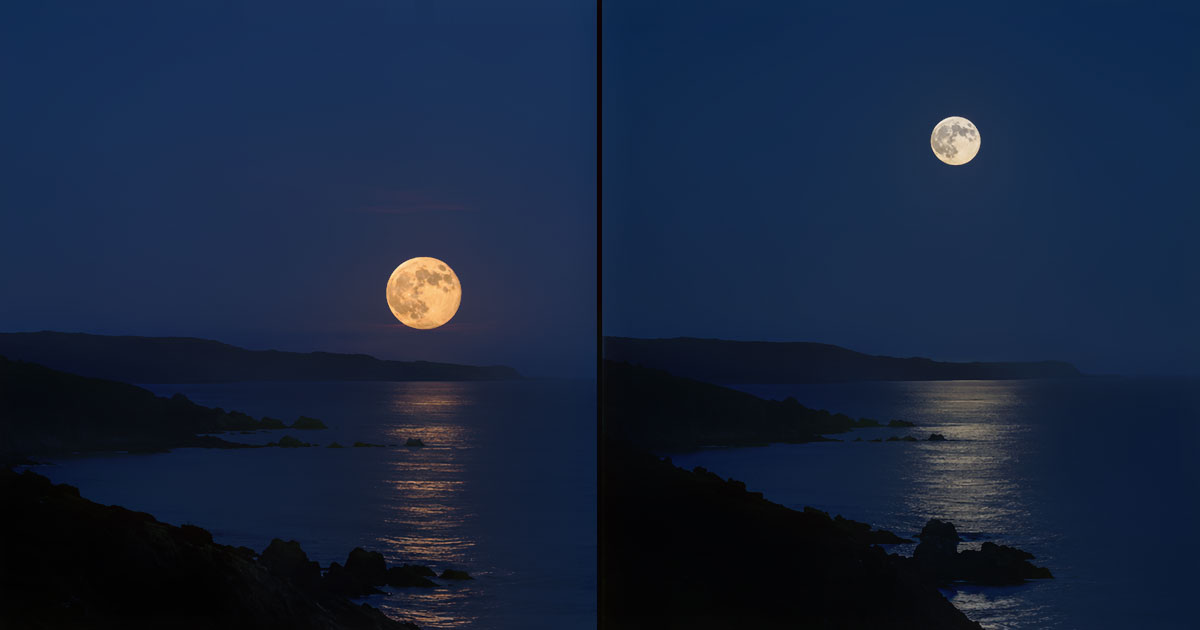
The moon’s orbit isn’t a perfect circle. At perigee it sits around 360,000 kilometers from Earth. At apogee that stretches to roughly 405,000 kilometers, a difference of about 45,000 kilometers. When a full moon lines up with perigee, it’s a supermoon, about 14 percent bigger and 30 percent brighter than a full moon at apogee, a micromoon.
That 14 percent size difference is genuinely hard to spot without a second moon floating alongside it for comparison. Astrophysicist Neil deGrasse Tyson has compared it to trying to notice the difference between a 15-inch pizza and a 16-inch one. The brightness difference tends to be the more noticeable one, along with the “moon illusion,” an unrelated optical effect that makes any full moon look larger near the horizon than it does higher in the sky.
What It Does to the Tides
A full or new moon already pulls tides higher than usual, an effect called a spring tide. When that alignment happens at perigee too, the result is a perigean spring tide, typically just a few inches higher than a normal spring tide. It’s real and measurable, just modest on its own. It only becomes a problem when it lines up with a storm surge.
Full Moon Isn’t the Only Kind
Full moons get all the attention because a supermoon reflects extra sunlight back at us in a way that’s easy to see. A new moon can line up with perigee too, but since a new moon is already dark, a “new moon supermoon” is invisible to the naked eye. It still produces the same perigean spring tide, just without anything to look at in the sky that night. When a supermoon instead lines up with a total lunar eclipse, it’s sometimes called a super blood moon, since the moon takes on a reddish color while passing through Earth’s shadow, appearing both larger and redder than a typical eclipse.
How Rare They Actually Are
About three to four full moons a year land close enough to perigee to count as a supermoon, out of the twelve or thirteen full moons in a given year. 2026 holds three: January 3, November 24, and December 24.
Where Our System Fits
None of this changes how we build our own calendar. We track the moon’s position against the zodiac every day regardless of its distance from Earth, so a supermoon or micromoon gets no special treatment in our system. This month’s Hunter’s Moon on October 26 is an ordinary full moon by that measure, nowhere near perigee, just further proof that the moon’s distance and its phase are two entirely different things.